AdSense for YouTube pub-8090345420272172 SHOBANA'S MUSINGS: August 2026

Monday, August 31, 2026

Malaysia Marks 69 years of Independence


This year I am away from home on Malaysia's 69th Independence Day celebrations.  Malaysia has grown and advanced exponentially, and yet social prejudice remains an issue. Have we done enough for the population to disregard someone's ethnicity, race, and religion and consider them on the same level as everyone else? There is no superior race or religion over another. Men have always discriminated in this regard. We are all bound by humanity's law and order, and if we fail to see that, we fail as humans and attract indifference and hatred.

There seems to be a stark lack of tolerance and understanding among our own citizens. Are our children taught to accept differences in others? It is important to know that no race can live in harmony without the other. We need each other to lift up a country like Malaysia, with its diversity and multicultural and racial ratio. We need to be role models, with acceptance and diversity playing a crucial role in moulding our world to be a better place for future generations.

This used to be a country for all. Is it still considered a country of peace and understanding? People condone injustices, which is why there are wars everywhere. We need to teach our children to understand the value of accepting the diversity that exists in our country in the first place, before we think of building better communities. Otherwise, it will all be in vain when our own teachers and leaders fail to embrace differences and practice them, and play lip service just to avoid the slurs and racial bias that exist on the sly. It is a sad situation for our children to undergo when they are criticised or discriminated for being different. We have to first accept that the world belongs to each of us, and that it is made up of differences.

Home is where the heart is, and my home is Malaysia.


Happy Independence Day, Malaysia.


The Faction Storytelling Method Modules 1-3

Now available on Amazon as well as Shobana Gomes' Bookstore. Available on Kindle/Free to Read on Kindle Unlimited.

Buy on Amazon

Monday, August 24, 2026

The Good, The Bad, & The Ugly

The good has a clean, polished veneer, and the bad is deeply offensive and selfish. Ugliness follows hypocrisy - an impeccably dressed human with a touch of class who hides behind pretentious smiles often constitutes one.

When we step back to examine the morality of these three shared human traits,  we can classify them through three distinct postures: the Good, the Bad, and the Ugly. 

The Good is quiet, grounded, and rooted deeply in kindness. It lives in a genuine soul who gives without seeking an audience, who listens to understand rather than to formulate judgment, and who honours truth even when it hurts. The good human is vulnerable and holds the umbrella for someone else in a storm. The good human shows their flaws and weaknesses and learns to improve themselves as they go along. Their compassionate nature grounds them as they seek to uplift themselves and others around them. The good strives for success, and their achievements are based on merit and sincere hard work. A good human thrives in the Good since truth is found there.


The Bad is filled with antagonism and revels in destruction. A bad human acts out of clear, undue anger, greed, and malice. You cannot brace an oncoming storm when the bad is around you, as assisting another is not in their league; instead, they add to your trauma and sadness. The Bad breaks rules, causes damage, and leaves scars. They don't wear a cloak of virtue like the good do. The wounds inflicted by the bad are dangerous and stay embedded in one for a lifetime. There are the jealous, boisterious, bad-natured, and envious ones who fail to see good in others. Most of the time, their ugliness is shown in their faces, and they become repulsive.


In the Ugly, the art of pretension, subtle hypocrisy, and self-serving deception is evident. While harbouring indifference, they show empathy. Behind closed doors, they connive and manipulate. They are those who preach ethics only to abandon them the moment personal comfort or vanity is at stake. They don't think twice about rebelling as they prioritise their ego, their status, or their private gain at the expense of genuine, trusting humans. 

What do these negative traits do to humanity as a whole? It destroys our shared foundation of peacefulness. When pretension becomes the language of survival, authenticity is forsaken, for deceitful ways and weaknesses. We become actors in a charade, constantly reading between the lines, questioning motives, and guarding our good emotions lest they be exploited for ambition. Humanity thrives on truth. It heals through simple, unpretentious actions where it is courageous to be real in a world obsessed with false appearances. To counter the ugly, we must choose the quiet, enduring beauty of being authentic.


Have a great week ahead - shobana


Tuesday, August 18, 2026

Poetry in Guyana - The voice of the people

Question: Why did Poetry make such an impact on Guyana?


I had the pleasure of listening to young poets from Guyana recite their heartfelt poems at The National Poetry Slam, held at the 19th-century Castellani House grounds in Georgetown, Guyana. It was part of the annual Literary Festival of Guyana celebrations. Organised by the Ministry of Culture, Youth and Sports, it is one of the most celebrated events to mark the literary festival.

Poetry in Guyana began as a bridge between formal European poetry structures and the rich, expressive cadences of Guyanese Creole and oral storytelling traditions. Poetry articulated the struggles of the people against colonial rule, political detention and imperial subjugation. Poetry was the language of collective desire for dignity, resistance, and self-identity.

Poetry here connects the landscape to mythology. The vast rainforests, waterfalls like Kaieteur, the mighty rivers and savannahs provide the perfect canvas for poetic imagination. Writers and poets alike use nature, not only for its scenery but as a metaphor for historical endurance and indigenous heritage.

Poetry is the vehicle that shaped the cultural society of indigenous, African, East Indian, European, Chinese, and Portuguese legacies. Poetry formulated a multi-ethnic society, just as the Guyanese Motto breathes "One People, One Nation, One Destiny."

Long Live Guyanese Poetry.


Have a great weekend.

-shobana-


On Shobana: 18/08/2026

 Guyana's Voice: https://www.shobanagomes.live/2026/08/guyanas-voice.html

Malaysia Marks 69 years of Independence

This year I am away from home on Malaysia's 69th Independence Day celebrations.  Malaysia has grown and advanced exponentially, and yet ...

Read the Sample

Read the Sample
To access the book, press on the image.

The Faction Revolution Modules 1-3 (A revolutionary method of storytelling)

The Faction Revolution Modules 1-3 (A revolutionary method of storytelling)
Fiction writing, the traditional way, can feel too distant, while traditional non-fiction writing can feel too mundane, almost boring to the readers. This is where Faction is the bridge, providing the legitimacy of facts with an emotional touch to a narrative. In this module, we move beyond "contemporary storytelling" into "Truth+Fiction, a revolutionary storytelling method that has worked for me to tell my stories. An unquestionable approach to adding facts within a fiction genre will allow you to preserve a veritable record of human history within a framework that is easy to consume and imagine. Faction is a pragmatic approach to a world losing its grip on historical truth. It has turned into a connective arc that ensures history remains alive, vibrant, believable, and, most importantly, relevant to the people of tomorrow. It is another way of ensuring that historical events and other factual information are widely read and disseminated. GET YOUR COPY FOR $0.99 at Shobana Gomes' Bookstore: https://shobanagomesbookstore.blogspot.com/2026/05/a-free-copy-of-nature-poems-with-every.html and get a FREE copy of Nature Poems)

Children of War

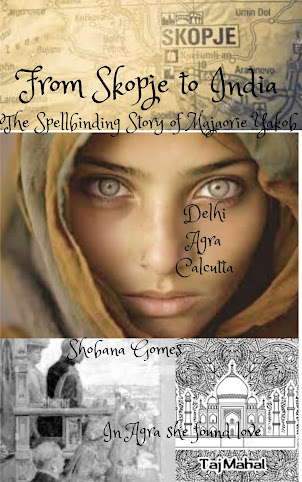
From Skopje to India

From Skopje to India
Majaorie, the Albanian, starts a new life. Read about her intriguing story.

From Skopje to India

Christmas Tales & Wishes